Friday, December 18, 2015

You Who Lift a Penny From the Gutter...

Last year, as some of you might remember who have been reading this, my daughter got married. It was a ton of fun, putting together all of the flower arrangements for her, helping with her dress, and the event itself was so amazing.

I wanted to give her and her new husband a gift of art that I would make, but with everything that was going on, the piece I had in mind just slipped among all of the things that needed doing, and I set it aside for their first anniversary.

Fortunately, the piece that I had in mind had enough power of vision in it to wait until I had time to make it. My daughter and her husband had gone to Victoria, Canada as part of their honeymoon. They took some amazing photos of Butchart Gardens which were so inspiring to me. I also saw among their photos a statue in the city which adorns the words of Victoria Canada's first poet Laureate, Carla Funk:

"You who
lift a penny
from the gutter
and with the same hand
point out stars,
find me."


this poem truly struck a chord with me, and I felt certain that if I created a piece of art that centered on those words, it would be a message from me to my daughter and her husband- my blessing - and my belief- in their love.


Among my daughter's photos, I also found one that was absolutely exquisite:


The photo of the creek with the wishing coins transported me to a magical place- and the Gardens really look like that. I could smell the fresh moss and pine needles, feel the cold stone, hear the trickling water, and it was so incredible.  Immediately I knew I had to create a piece that "married" the idea of the "pennies in the gutter" to the "stars". 

I thought about how that would reflect the poem. The coins in the painting were not pennies to lift "from the gutter," but they were the opposite- wishes thrown into a gutter, if you will, perhaps with the same purpose. Either the penny was lifted to save due to physical poverty, or it was lifted for luck. But either way, the point is the same- the notion of hope, that a person who was special enough to find hope in something as insignificant as a penny, and could also have a mind so open to believe in eternity- to believe in things beyond this world - and to believe in the promise of the future - was desired by the writer. In the painting,  My desire was to represent this back-and-forth reflection between the sky and the water through hope.

I decided to use the technique I had experimented before on both the New York Gapstow Bridge work and white feather painting - Gesso on board, and then acrylic, with soft pastel on top.

My first step was to sketch out the concept- I pictured this very same image of the creek and the coins at the bottom, but imagined the trees reaching up to the stars, literally as if the coins could be a "reflection" of the stars. Next I covered the whole thing with clear gesso.

In this case, the coins and the stars would be important. I decided to go ahead and use masking fluid for both so that they could sort of "recede", as stars do, once I removed the product. I could then go over the coins with some color to make them look more realistic.

Unfortunately at that point the piece laid dormant for awhile as other things came to the forefront, but I was determined to complete it for their anniversary. I found myself hesitant to put on the fist strokes of color- I think because this piece was so important to me. I knew I wanted to include the poem somewhere, and I played around with how on tracing paper. I was making the mistake of trying to see it all complete and make it perfect before starting.

Then,  when there just wasn't time to worry anymore, I just made myself start painting. Something, anything. Anything that "felt" right, lightly, with acrylic.


At that point I felt confident enough to paint in the sky. There was a bit of a dilemma as I made this in my mind: WHERE would the light theoretically be coming from? If I paint directly from the photo, It would seemingly be daytime, because that's when the photo was taken, under a deep canopy of shade trees. I really wanted that beautiful pop of light green highlighted moss in the upper left of the creek. But then, how could it be night time then, so the stars would be out? After some worry, I decided to create a world in my mind where a very bright moon was directly overhead. 

When I laid in the sky, I used mostly cerulean blue, with some mars black. I played around by putting some white to the right, and it gave a little mystery to the sky, so I left it.


After smoothing out the sky, I gave myself permission to really go for it with the acrylic. I even pulled out the palette knife for the stone, and got in some dimension. It was a lot of fun. 


I painted in some trees in the foreground and got the colors for everything mostly where I wanted them. This shows after the paint dried and I rubbed off the masking fluid for the stars.


For the coins, I removed the masking fluid, and then went over them with a brush with a little color, so that they'd look more realistic. Here are some really close-up shots of how that looked, and also how I added the soft pastel to pull out more color for the soft browns, mossy greens, deep blues and purples of the creek.


As far as putting in the words, it's funny, but the way the sculptor put the words of the poem in that tree sculpture is sort of parallel to how I might have chosen to do render the words.  (Although without the "ribbons" behind them) How wonderful to be looking at the words of the poem while you are looking at the stars. I wanted to allow that to happen in this piece as well, and also to champion the poet's idea of "finding". I liked the idea of "hiding" the words a bit, and through exploring the growth in the nature, finding a completion in the soul. 


I thought that there wouldn't be anything better than the incredible joy in making this piece but there was- and that was seeing the look on my daughter's face when I gave it to her. I am so gifted to have a daughter who just...
gets me.
and more than that, who really loves me.

It's also interesting that I found so much freedom in making this piece, that I might just do more with my own poems. You never know where the path takes you on this creative journey. You start down one way, looking at the ground, but then, there are also the stars.

Leaving this for you all as a Merry Christmas and thank you for reading my blog!


Tuesday, December 15, 2015

Frosty Feathered Friends

I recently completed several mixed media pieces on board, just using watercolor as a background and popping out the subject matter in soft pastel.. I'm finding this technique to allow rich layers and varied textures in the pieces, and I seem to quickly get the best of all the worlds.

Over the past few weeks I completed a series of "wintery" birds. This started with a simple feather as a gift. Symbolically, this little eagle feather was almost autobiographical. I'm learning a lot about the philosophies inherent in Native American culture, which tie the animal world, and really all of the natural world together with humankind. The feather connects the owner to the bird. In this piece I just took a piece of watercolor board I had laying in the studio, painted a background in watercolor and then made the little feather with soft pastel. It went really quick and it turned out to be a perfect Thanksgiving gift for a special person in my life.


After the feather, I made a cardinal in memory of my dad, just for myself, but after I made it I decided that the technique was so fluid and gave such good results, and also, that I was really enjoying focusing on the birds. I thought I should keep going and make several, to share with the people at Faith Arts Village Orlando for their holiday show. Here are a few that I made-

"Chickadee"


"Bluebird in snow"


"Cardinal in Snow"


"Snowy Owl"

They all were created in similar fashion as the little eagle feather- watercolor and soft pastel. I did use some colored watercolor pencil, and in some cases chalk pencil, on the eyes and beaks, to get more detail in. Each piece happened slightly differently as I tried to get the best effect. For instance,  I sketched the scene lightly in pencil, then painted in the watercolor background, rendered in the eyes beak and feet with either watercolor pencil, chalk pastel or both. It was really thrilling how quickly each piece seemed to come out of my hand. I really just had FUN.

After applying water to perfect the feet, eye and beak, the body of the bird was rendered with soft pastel. For the snowy owl above, I started with all the white, added in the grey shadows and blended, and then applied workable fixative. When that dried I went back in on top with more white highlights, and also the black feathers in the back. More fixative, then a final work of the white and final matte finish. For the cardinal above, I painted in the grey background and the grey shadows in the snow, went for the reds of the bird with soft pastel, drew the tree needles with watercolor pencil, sprayed fixative, and finished up with the white snow (the falling snow I made by rubbing pastel on rough sand paper and also drawing dots) and also covering up some of the tree needles and around snow with final coat of white pastel. Every piece was finished with a coat of matte fixative.

In the middle of pouring my heart into these works, some things presented themselves that reminded me of the fragility of life, and how are we are so connected to the animal world. And this shook me to my core. It even made me re-evaluate my entire lifestyle, in order to live a more honest life. It's funny how each foray into an avenue of art seems to make me understand who I am, despite myself. It can be a really scary and frustrating experience, but I know that is how it is supposed to go for an artist, and I've committed myself to that journey. And so be it.

I decided to donate a portion of my profits to the National Audubon Society. My dad used to love birds, and used to call me his "Little Chickadee". I saw that with a donation there I could symbolically "adopt" a bird, and they sent me an "adoption certificate" along with a plush black-capped chickadee that sings its call when squeezed. It came on my birthday. And I know that my late father helped me to paint each one of these pieces.

It was so surprising to me how many people resonate with the feathered friends, and also, how many people seem to have feathers follow them! I made so many new friends at the show. Many of the birds flew to new homes, and my soul was nourished into its next artistic adventure!


Monday, November 9, 2015

Painting the Flying Spirit of the Bird

When I last posted, I was following the feathers. They led me to the peacocks, and then, as always happens in the creative process,  I ended up somewhere I had not even imagined!

I was recently inspired to create some art for an exhibition hosted by the Orlando Museum of Art called "Animals!". It was funny that this exhibit came up, because I had put off creating my peacock painting in alcohol ink for a long time, the whole process seeming overwhelming. If you followed my last post, you'd see how I had struggled, but really wanted to move forward with this new medium, and well, how I was so enthralled by the peacocks.  The next logical step was just to DO IT, and the exhibit provided the perfect motivation.

Here's the photo from the last post of the incredible creature that I chose to render.


Unlike the earlier alcohol ink works that I had done, I decided that with this one, I'd use a couple of different little tricks to help me start. First, I used some watercolor to sketch in the image of the bird. This way, I could always pull it up with some water if I wanted to make changes before starting on the alcohol ink. Then I did something else new- I used some masking fluid to outline the bird, thus letting me be a little more free with creating the background. I was surprised at how much it looked like an angel!


The next step was dropping in some different greens, and brown, and blotting them with paper towel to get a first layer that was homogeneous. I knew I wanted the top level of the bird to have a different treatment, so I focused on creating sort of a horizon line. Then I just had some fun dropping in some other colors to create shading within the greens.


This next photo shows what happened when I also dropped some rubbing alcohol to mix everything up.


I went at the colors as they mixed with a little brushing with dry brushes, and some blotting with paper towel, to create this look.


At this point I decided that the background needed to have a little more definition of darkness under the wings, to help the bird stand out from the background. I played a little with that. Also in this picture you can see how I started to put in the upper part of the background. My thought was to make it appear more like "sky" while the bottom looked more like "earth", and the bird itself and the activity of its flight was the transition. The technique I used for the sky was to drip some colors on the left edge of the paper, and lift the paper to let it run to the other side. You can see how things started to get a little messy over the peacock's head, but I knew I was covering that with bold and dark colors, so that was ok. I played with the sky until I liked the look.


Here's how it looked when I removed the masking fluid. Still a lot of work to do.


This was the tough spot for me- to just get bold and start dripping color for the bird. However, Once I told myself to loosen up and do whatever needed to be done for the whole piece, including working more on the background, so be it. I started light to dark. I decided to use even more layering of color and drops of alcohol ink to make the "earth" part of the background interesting.


Next came a critical point in the piece for many reasons: I worked in the very dark feathers behind the orange ones, and started to do the detail of the "eyes" on the peacock feathers. I started to get really frustrated and went back and forth washing over and erasing things and redoing them several times. Once during that day I was reading and happened upon this quote by Robert Henri: "Paint the flying spirit of the bird rather than its feathers." Reading that gave me permission to really let my hand knew it was supposed to do all along.


Here is the piece as finished- I ended it with more work on the wings, tail, and doing some free splattering of fun. and I think he was finally flying!


I was so honored that this work, plus two others were selected for the show at the Museum, which turned out to be an amazing show, and so thankful that they were received wonderfully. Now, I'm inspired to create more!

Please comment if you have any questions!!!

Thursday, July 16, 2015

Playing with Peacocks, and Discovering Alcohol Ink

Well, I was going to wait a bit til I had more work done with a new exciting medium that I discovered, but I thought I'd take a break from what I'm doing to put it down in writing.

It all started last spring when I met a fellow artist at an event at the Orlando Museum of Art. I did not recognize her, but I did recognize her work, and as we conversed I discovered that she too was a lover of Yupo paper! As we discussed our techniques, I told her how I was unhappy with some watercolor brands, and asked her what she uses. I learned at that time that she uses alcohol ink! Apparently, though, a lot of people do. It is a permanent medium, unlike watercolor on the Yupo that could, conceivably, be washed away.

This is how it always seems to happen with me- I usually stumble upon something accidentally that the whole world seems to have known since the dawn of time, and I feel kind of silly.

Immediately, I thought of a subject that I had been wanting to capture. When I was visiting an aquarium last spring with my sister, I saw this incredible giant octopus. I stood there mezmerized for what could have been half an hour, and I know she wanted to move on, but I just couldn't stop studying it. So I took a video to capture it a bit.


Well, I figured what an APPROPRIATE subject to test out alcohol ink on, an octopus!! The Orlando International Fringe Festival was coming up, where I have shown my art for several years, and I took that as a goal for finishing the piece to submit for the show. It would be a perfect venue, I figured, since the spirit of Fringe is to move beyond your comfort zone as an artist and discover something new.

I really had no idea what to do. All I knew was that the inks worked similar to the watercolors, except that instead of being soluble with water, I would have to use alcohol, and/or a mixative. I went to my favorite store near me, Art Systems, to see if they had the materials, and I figured it was meant to be because they only had 5 colors, which happened to be the exact ones I would need to complete the work. I did have to pick up a black from another store, but I had most of what I would need. I picked up a spare set of watercolor brushes, and went to work on a new pad of 9 x 12 yupo.

I had looked on the internet a bit, but honestly there was very little to teach me how to do what I wanted, so it was going to have to be complete experimentation. I honestly had no idea if it would work or not.

The first thing I did was to pour out some of the inks in separate wells of a palette, and literally brushed them on the yupo. I discovered pretty quickly how different the alcohol ink was than watercolor (at least as far as using the same brush-on techniques I was used to) because:

1) It dried REALLY fast, even the inks I was using in the wells of the palette, so I had to work very quickly. Once the ink was squeezed out of the little tube, I had only a few minutes to sop it up and lay it down onto the painting.

2) Unlike the watercolor, there really was not a complete "erase" ability. In other words, if you made a mistake and tried to pull up the ink with alcohol, there would still be some pigment left on the paper, it wouldn't be completely white. But:

3) It did allow for layering since it did dry fast.

4) The bad part too was that it was really messy - as in permanent messy- and everything smelled like a doctor's office.

So since I didn't have a lot of time to worry, I just brushed out an abstract version of my octopus that looked like this:


From there, I just played around with squeezing out more pigment, and the only detail I really concerned myself with was the eye. The main reason I thought that alcohol ink would be fun for the octopus was dropping pigment and alcohol for all of the little suction cups, and I was right. 

However, I did learn early on that there was not a lot of control. The size of your "drop" depended on the size of the dropper obviously, and just a little tiny dropper size really bled big. 

I thought about getting anal about it and upset, and figuring out how to fix it, and then I decided to just...have....fun.... 

So in the end the piece turned out looking like this: 


And I liked it. Keep in mind that this photo really doesn't explain it well. There was a lot of glare as I took the shot.  A better one, though with less detail shows it as it hung at the Fringe Festival a couple of weeks later: 

I titled it "Dancer in the Deep", because it stuck with me that the lady at the aquarium described the octopus we were viewing as having a real personality, and she said she was happy that she was "dancing" for us.

And the cool thing is- the art was claimed before the gallery even really officially opened, and I was told that it went to the Fringe Festival's President of the Board of Directors. I was COMPLETELY HONORED and overjoyed. 

Well, this new medium, with its bold colors and dreamy effects had really taken ahold of me in terms of its possibilities. 

After Fringe, I was floating a bit creatively, and frankly really just busy with the children's book promotions and marketing, as well as beginning some new books. I did not know where I would be heading fine-art wise.

Then I decided to again, follow the feathers.

Before Fringe, I had gone to an event at the Polasek Gallery and Sculpture Gardens where they had brought in some birds of prey to view, they had a bird exhibit, and an exhibit about the peacock as the Winter Park Logo and its history. While speaking with the curator and sharing my "feathers" inspiration (as outlined in this blog previously), she mentioned a place in town where a man raises birds, and she encouraged me to get ahold of him- maybe he would sell me some feathers, and share some info with me that would be inspiring.

I was a bit hesitant to follow that path, as I really didn't know this fellow. But, I took a chance and decided to call him up, and he invited me to visit what he described as his "bird sanctuary". He raises peacocks, and the property was just beautiful, on a lake in downtown Orlando. It was a little sketchy, I'm not going to lie. However, in the end I was blessed with a lot of his spirit and love of nature shared to me. 

The first thing that happened when I got there was that there were a lot of peacock feathers hanging around. He gathered them up, gave one to me, and told me to look at it as I turned around in different angles from the sun. He said that it was impossible to paint it. I nodded my head, but inwardly I decided I'd try to prove him wrong.


He brought me on a tour of his property, including a beautiful lake on one end with some incredible lily pads. 


The flowers were incredible. I wish I could describe it to you, but it really is impossible. He plucked them from the lily pads and had me smell them. I smelled the purple one and can only describe it to you like heaven. And then I smelled the blue one, and again, I can only describe it as heaven, but it was completely different, and I can't explain how that is possible. He had a wonderful way of explaining that that scent was what Moses smelled as a baby floating down the Nile, that brought me to tears. He had, earlier, made honey from those flowers (he showed me where he had kept bees and made honey years ago). Later he put them in water and I got to bring them home!


He had some incredible peacocks outside, and I got a photo of one with his wings open that was breathtaking.


Also I got to have a whole lot of fun with a bunch of baby peacocks, and learned that they are not shy of people, or cameras. :)


Well, when I decided to pick up the alcohol ink again, I wanted to work on all of this, as it was just so beautiful. The flowers were the first thing I approached. I did look a bit more online, and saw a lot of people approaching work with this medium by dropping the color directly onto the paper, thereby sidestepping the problem of having it dry in the wells of the palette. I decided to try that this time. I'm going to post a video I took as I was working, but please keep in mind that I was (and am) still experimenting, and as I look at this now I realize how painfully slow I was still working.


 Also, as I will show you later working from light to dark was something I had not mastered yet, and there are some things that can be done with this. Here I did not use the palette at all. I had bought a couple of more colors, including a green that was more olive-toned. I dropped it down with a bit of the brighter green and in the end realized I had to use quite a bit of alcohol to lighten it.

The piece turned out kind of cool. It didn't look like the flowers I started with, but I don't mind because it's all in the game of learning, and the end work turned out pretty. I called them "Lotus Flowers" because of the biblical reference that was rendered by the bird breeder, and I love all of the spiritual folklore of the lotus flower. It was so neat to see the actual flowers close up at night and open during the next morning. 


The other thing I discovered was that really, working with 91% rubbing alcohol is really the only thing that works. the 70% doesn't cut it for lightening pigment once its down, and the higher concentration really cleans the brushes better.

The next piece I wanted to play with was a peacock feather- something colorful and easy to recognize, and I knew, like the octopus, I could play with it a lot and still have its spirit shine through.

Before starting the new piece I got some squeeze bottles with tiny nibs to use for very small amounts of pigments so that things wouldn't bleed too fast and get out of hand. I also had seen online about using some q-tips, so I got those to experiment too, and laid out everything knowing I would work just as fast as I could, having everything easily accessible. The right kind of alcohol, plenty of paper towels, etc. It was getting easier and I was learning how to be prepared.

After some more research I learned how to lay in some background, lightly, and then go for the layer above. The piece changed a lot as it went but I played just enough to make it look like I had captured the spirit of the feather.  I had so much fun thinking of the spirit of the incredible work of art that God made to hypnotize the lady bird as she looks into those blue eyes, maybe this is what she sees....


Next I am tackling that incredible peacock as he flies. I know that has the potential to be overwhelming but I plan to approach it in the same way as these, with no expectations except to let myself be free and "go with the flow" as it were...

And I like to think that maybe, sometimes, painting exactly what you see is not the goal. Maybe that's how I proved the peacock guy wrong- you CAN paint a peacock feather, if you don't LOOK too much, but FEEL it flying in your heart.

Monday, December 22, 2014

Mother of the Bride, Part 3- The Winter Wedding Comes Together

This wedding became real to me months before the actual occasion, but not in the way many do for the mother of the bride. I was not in charge of picking out everything or paying for everything, thank goodness. But, my daughter had entrusted me with a precious task, which was to design the flowers, and to design the layout of the wedding site in general. For me, once I put pen to paper to design and invest my creative energy, that's when it started to get real. The funny thing is that my daughter completely understands this, because she is also an artist. She is also brilliant, because she knew this would keep her emotional mom busy and therefore less likely to worry about everything!

I began the flower design by researching what kinds of flowers are available in winter. My daughter's wedding would be held at Autrey Mill Nature Preserve just north of Atlanta, Georgia, on Dec. 13th. There are historic buildings on site, including a  historic chapel built in the 1800's, where the ceremony would take place. For the flowers, she wanted mostly greens, and only white flowers.

Because of my earlier research on birth flowers, I already knew that her birth flower was the chrysanthemum, and that the flower had a lot of significance in Japan, which is where half of her heritage lies. So, the chrysanthemum was a natural pick for part of the arrangements. However, neither one of us liked the "Spider mums", and I didn't really care for the little button mums for a wedding- too common. My early research online led me to what was called "incurve mums". Later I found that this term was pretty broad, and I had to narrow it down.

For my daughter's bouquet, I wanted to go with all white to set her apart, no winter greens, and a really special, delicate flower. I thought about Lily of the Valley as a traditional sweet-smelling wedding flower, but later found out that each one of those little stems would cost about five dollars and we probably needed 50. So, plan B... I saw something online about freesia, a flower that I had in my wedding bouquet years ago. It was a bit pricey, but well worth it for the beauty. I figured that we weren't paying a lot for the rest of the flowers, so we could splurge for the bride.


I decided to use the mums for the bridesmaids and the table centerpieces, and the freesia for the bride. I also added in some white roses in the design for the bridal bouquet. 

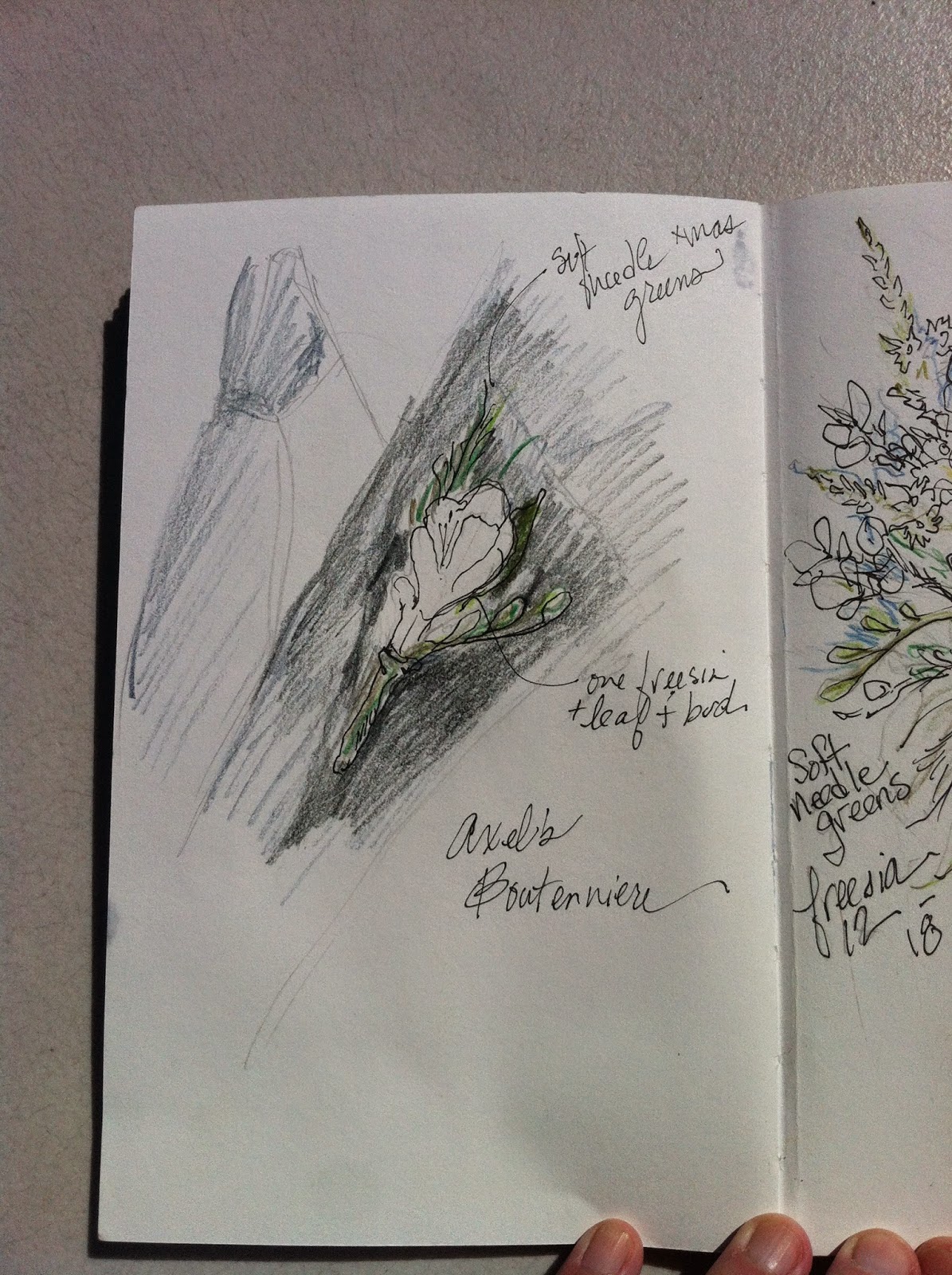
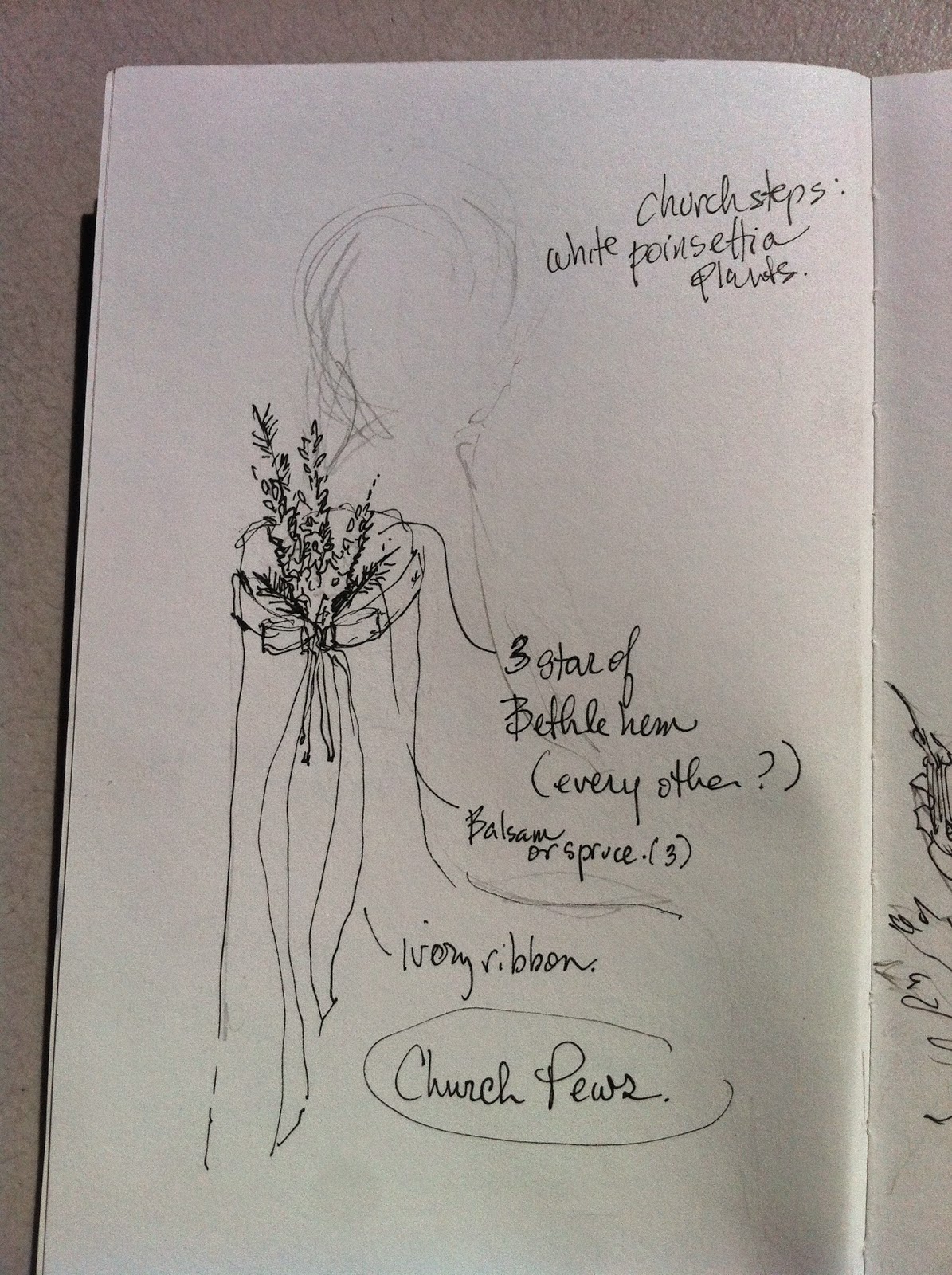
The other really special flower I found was called "Star of Bethlehem", which comes out for winter. I really loved the symbolic significance as well as the design, and decided to use them for the bride, bridesmaids, church pews, and groomsmen's boutonnieres. The groom would have a freesia.

The last little addition to the design during the drawing stage were the pussy willows. I love this winter reed, and my daughter went nuts when they actually appeared to us. We are both bunny lovers, and she said the soft buds felt like bunny tails. I decided in designing that they would add a lovely whimsy to the arrangements, and I was really right.


After the drawings were done, I discussed everything with the florist who would help me order the flowers.

Luckily, we had been referred to Tucker Flower Shop in Tucker, Georgia. The consultant who was ordering the flowers for me was unbelievable, both with his knowledge, design sense, and his ability to relate to my vision. He and I hit it off just about from the start. And it didn't hurt that he was crazy about all things Japanese. He did a lot of research on all of the flowers, and we settled on white "football" mums- they gave us the most bang for the buck, and they were gorgeous.

We had to go through the "greens", because I decided that there were some leaves there that weren't your typical "Christmas" greens, that I wanted.  I really wanted to add some juniper, because of the gorgeous blue-colored berries. Something told me to do that, and as I did, I remembered that I used to use Juniper a lot for our Advent Wreath at home- my candles were always 3 deep blue and one purple. I don't even know if it was a coincidence that this came together during the Advent season, as it has been years since I set up that wreath. But it was really a pretty combination, especially in the woods.

Juniper- a whole case!

Lastly, we added a whitish green plant called "dusty miller", a purplish leaf called Agonis,  and a fluffy fern called"plumosa", all which the florist had identified from a photo of a bouquet that my daughter liked.

Agonis (above) and Dusty Miller

Tree fern (shiny, above left), and Plumosa (or "Asparagus fern")


We picked up the flowers the morning of the Thursday before the Saturday wedding, and all that day was focused on the centerpieces first and then the bouquets. I figured I'd wait til Friday for the boutonnieres since once they were done, I couldn't have them in water.

Loading up the car


Luckily I had the help of a couple of her bridesmaids for part of the time, and her future mother- and father- in law were so gracious in letting me use their basement for everything. They helped me place everything in buckets and trim the ends of all of the flowers and greens, including cutting up the greens themselves into workable pieces. This was saying a lot, especially for the juniper.

 Juniper and Pussy Willow

We placed the Freesia and Star of Bethlehem inside though, since those flowers needed to open a little before the wedding, so they would have to be in warm, or at least room-temp water. When all that was left were the bride's flowers in that bucket after making the arrangements, I placed them in a vase and waited until the last moment to put them together for the bouquet.


My daughter had bought mason jars with candles inside for the centerpieces, so I decided to go with some pie plates to place the jars, and surround them with floral foam to build the centerpieces. We soaked them all outside and brought them in one by one as we worked. All of the greens we separated first and laid in piles so they'd be easy to pull from. I also separated the greens in a separate area that would go into the bouquets from those that would go into the centerpieces to make sure we had enough. The pussy willows had to be cut in sections carefully so I'd have enough for all of the centerpieces, bouquets and boutonnieres (for those, I used the very tender tips). 


I started the arrangements with the mums, then added the juniper since it was a little tricky to work with, filled in with the rest of the greens and added the pussy willow last.  Once we were done with the centerpieces they went outside because the temp outside was close to the perfect 38 deg. temp for the flowers- later we placed them in the garage so they wouldn't freeze overnight.


 The bouquets came next, and thankfully there were only four bridesmaids because I was wiped out by then! They contained the same as the centeripieces- 2 mums each, cedar, pine, fir, juniper, agonis, pussy willow, and for these also I added the star of bethlehem.


Next I made the flowers that would go on the church pews- these had the Star of Bethlehem, Agonis, Cedar, Pine, Fir, and Juniper. I used the Dusty Miller mostly for these, because their stems ended up being too short for the bouquet designs and they were too delicate for rooting too much into the centerpieces.


Thursday night, I still had to finish up my daughter's hem (which I described in the previous post), so the flowers sort of came to a halt. The next morning I was up at it again making the boutonnieres, and I snuck in time after the rehearsal dinner that night to finish tying bows on all of the bouquets. And at the last minute, the bride's freesia was opening up beautifully, and late Friday night I put my daughter's beautiful bouquet together for her.
WHEW!!
Bride's bouquet- Freesia, Star of Bethlehem, White Roses ("Eskimo"variety)


 Groomsmen boutonnieres (above) with Star of Bethlehem, juniper, pussy willow and plumosa fern.
Groom's boutonniere (below) with freesia and plumosa fern


Groomsmen boutonnieres

 Planning the site...

I laid out the reception plan in terms of the tables we would need to seat the guests- I had done a preliminary plan, but once I was up there for the wedding and we had a final count, it was time to put pen to paper again.  It was fun to figure out where people would be and to envision making s'mores at a bonfire, tended to by an eagle scout who had made the fire pit for the site. We took a trip out to Autrey Mill the first day that I arrived so that I could get final measurements. I was having so much fun I broke their tape measure in the process! OOPS!


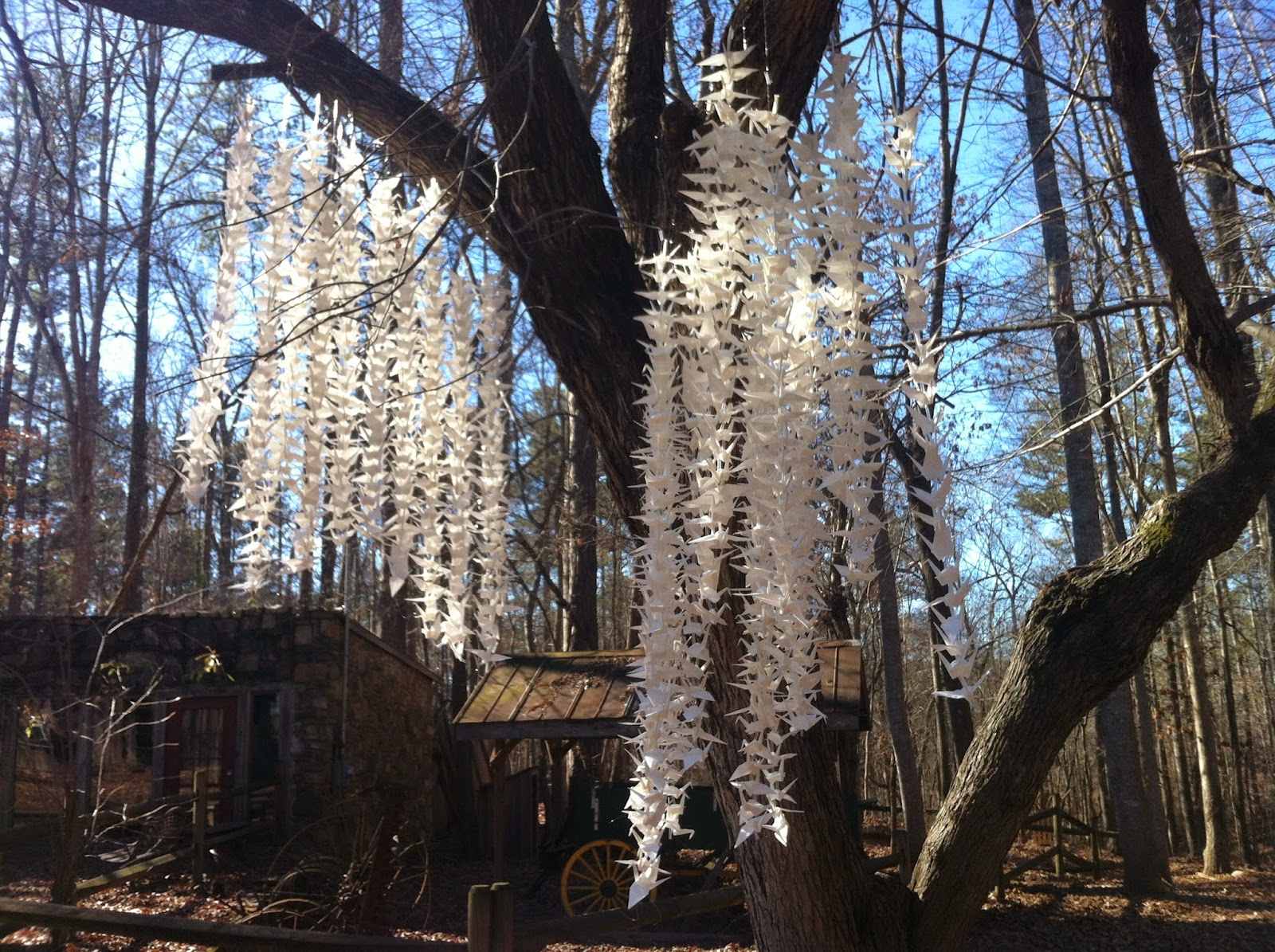
One of the visions that I originally had for the wedding at the very start were for making the traditional wedding cranes.  In our family, many times for weddings we traditionally fold 1,001 paper cranes, which is an old Japanese tradition, to wish the bride and groom health and a long, happy life together. From the moment I first saw the site months before the wedding, I knew that a tree near the pavilion where the reception would be held would be the perfect place for those cranes. I could just see them hanging there in the breeze. I wasn't sure if it would really happen, but all I had to do was say the word, and my sister-in-law went to work on half of them, with the rest made by bridesmaids, friends, myself, and my daughter.


My daughter strung the cranes on fishing line, 40 strings in all, 25 cranes per string, with one having 26. In-between she placed a cut piece of plastic straw to separate them a bit. I had the idea of tying the strings end to end so that the strands could be just hung over the big branches and we didn't have to tie anything or actually attach them to the tree in any way. In the end, I wasn't sure if hanging those strings of cranes was feasible, but the guys got it done, and it looked absolutely spectacular. I planned to place the cake table and sweetheart table under them so that the bride and groom could be framed by them. It was so magical to see them flowing with the wind.


After all was done, I really didn't even believe all that had happened. But I am so incredibly grateful to have been such an integral part of my baby girl's wedding, and it's something we'll always share.